Monday, November 17, 2025

The year 2024 in spaceflight

Czech version: Rok 2024 v letech do vesmíru

The year 2024 saw a record 253 successful rocket launches – the most in the history of spaceflight. The US dominated with 155 launches, followed by China and Russia. SpaceX set new standards for reusable launch vehicles with its Falcon 9. 

In 2024, we recorded a record 253 successful launches - 42 more than in the previous record year of 2023 - representing the highest number of rockets sent into space in a single year to date.

Countries' share of rocket launches

The countries with the highest number of successful launches are the USA (155), followed by China (68) and Russia (17). The remaining 16 launches are shared between Europe and four other countries.

By rocket

Last year, SpaceX's Falcon 9 was once again the most successful launch vehicle (132 launches). 127 launches were performed with a first stage that had already been used at least once before, with only 5 missions using a brand new stage. The Chinese Long March family of rockets came in second place again, with 49 launches.

By spaceport

The busiest spaceport last year was Cape Canaveral in Florida with 67 launches. Second and third place also went to spaceports in the United States—Vandenberg with 47 launches and Kennedy with 26 launches. Fourth and fifth place went to Chinese spaceports – Jiuquan with 21 launches and Xichang with 19 launches. Sixth place, with 13 launches, went to the New Zealand spaceport Māhia.

People in space

In 2024, a total of nine manned missions were launched into space—five missions from the United States, with a total of 16 people, two Russian missions with a total of six people, and two Chinese missions, also with six people. 

Last year, another record was set for the number of people in orbit at the same time (19 people), specifically on September 11. This was achieved after the launch of the three-member Soyuz MS-26 mission to the International Space Station (ISS), which joined nine crew members aboard the ISS, three crew members of the Chinese Tiangong space station, and four crew members of the Polaris Dawn mission.

This mission also made history by performing the first commercial spacewalk, during which two crew members left their Crew Dragon spacecraft. This mission also set a new record for the number of people—four—simultaneously exposed to the vacuum of space.

Space missions

Two important scientific missions were launched in October: NASA's Europa Clipper mission to Jupiter's moon Europa, which aims to search for traces of an ocean beneath its icy surface, and ESA's Hera mission to the Didymos binary asteroid system, which was struck by the DART probe four years ago to test the kinetic method of redirecting an asteroid's trajectory. On Mars, the Ingenuity helicopter (NASA) ended its operations in January when its rotor blades suffered critical damage.

This year also saw significant lunar missions. The Chang'e 6 mission of the Chinese space agency CNSA successfully completed the first-ever mission to return samples from the far side of the Moon. The SLIM mission of the Japanese space agency JAXA and the IM-1 mission of Intuitive Machines achieved soft landings on the surface of the Moon, but both landing modules overturned during the final descent, leading to the early termination of their missions. Thanks to the SLIM mission, Japan became the fifth country to achieve a soft landing on the Moon.

New launch vehicles and unsuccessful missions

Last year saw six unsuccessful missions and two partial failures.

2024 also saw several maiden flights of new launch vehicles, including the American Vulcan Centaur rocket and the Chinese Gravity-1 and Long March 12 rockets. The European Ariane 6 rocket also made its maiden flight, although there was a partial failure. 

SpaceX made progress in the development of the Starship spacecraft, with flight test 5 achieving the first landing of the first stage. In addition, April saw the last launch of a rocket from the Delta family, the Delta IV Heavy variant.

Source: 2024 in spaceflight

Rok 2023 v letech do vesmíru

Saturday, March 1, 2025

GenAI and LLMs development, trends and implications (17. - 23.2.2025)

Releases:
OpenAI cancels o3 release and announces roadmap for GPT 4.5, 5
OpenAI releases operator, an AI agent for web-based tasks
OmniHuman-1 released - AI-generated human animation
Latin America launches Latam-GPT to improve AI cultural relevance

Vision and video generation:

In software development:
Prompt engineering: Is it a new programming language?
Zero human code: What I learned from forcing AI to build (and fix) its own code for 27 straight days

And software testing:
Meta introduces LLM-powered tool for software testing
TDD and generative AI – a perfect pairing?
Generate unit tests with AI using Ollama and Spring Boot

Building apps:
Emerging patterns in building GenAI products - Guardrails
Build scalable GenAI applications in the cloud: From data preparation to deployment
Building intelligent microservices with Go and AWS AI services
Spring AI with Anthropic’s Claude models example

LLMs:
How LLMs work: Pre-training to post-training, neural networks, hallucinations, and inference
Dive into tokenization, attention, and key-value caching
The Delegated Chain of Thought architecture
A comprehensive guide to Generative AI training
Semantic clustering of user messages with LLM prompts - tutorial

LLMs and search:
Have LLMs solved the search problem?
Search: From basic document retrieval to answer generation

RAG:
Building a simple RAG application with Java and Quarkus
Creating an agentic RAG for Text-to-SQL applications
Multimodal RAG with Colpali, Milvus, and VLMs
Retrieval Augmented Generation in SQLite

Agents:
AI agents from zero to hero – part 1
Agentic workflows for unlocking user engagement insights
Azure AI Agent Service now in public preview for developers in AI Foundry SDK and Portal
Observability and DevTool platforms for AI agents
AI Agents: Future of automation or overhyped buzzword?

Future:
40% of AI data breaches will arise from cross-border GenAI misuse by 2027

Saturday, February 1, 2025

GenAI and LLMs development, trends and implications (20. - 26.1.2025)

What’s the real ROI of AI in 2025?

Google releases experimental AI reasoning model - Gemini 2.0 Flash Thinking Experimental
DeepSeek open-sources DeepSeek-V3, a 671B parameter mixture of experts LLM
Nvidia Ingest aims to make it easier to extract structured information from documents
Microsoft Research unveils rStar-Math, advancing mathematical reasoning in Small Language Models
Microsoft Phi-4 is a Small Language Model specialized for complex math reasoning
Amazon Bedrock introduces Multi-Agent Systems (MAS) with open-source framework Integration
Luma AI’s Ray2 video model is now available in Amazon Bedrock

Want to integrate AI into your business? Fine-tuning won’t cut it
Building successful AI Apps: The dos and don’ts
Agentic Mesh: Towards enterprise-grade agents

Advancing AI reasoning: Meta-CoT and system 2 thinking

Choose a database with a hybrid vector search for AI apps

A framework for building micro metrics for LLM system evaluation

Why LLMs suck at ASCII art
Large Language Models: A short introduction

Human minds vs. machine learning models - exploring the parallels and differences between psychology and machine learning
Understanding emergent capabilities in LLMs - lessons from biological systems

Chain-of-Thought Prompting - a comprehensive analysis of reasoning techniques in Large Language Models

RAG isn’t immune to LLM hallucination

Designing, building & deploying an AI chat app from scratch - part 1 and part 2
A guide to deploying AI for real-time content moderation
Real-time data streaming with AI

How LLMs are going to change code generation in modern IDEs
Meet Junie, your coding agent by JetBrains
"Fix with AI" button to automate Playwright test fixes
Collaborative Intelligence - maximizing human-AI partnerships in the workplace

Building effective agents with Spring AI (Part 1)
Fresh data for AI with Spring AI function calls
Powering LLMs with Apache Camel and LangChain4j

Saturday, January 25, 2025

GenAI and LLMs development, trends and implications (13. - 19.1.2025)

Prompt engineering has become an essential skill for working effectively with large language models (LLMs) - guide on the best prompt engineering books
Google unveiled PaLiGeMMA 2 - a family of vision-language models (VLM)
NVIDIA’s announces DIGITS - its first personal AI computer

Projects like AYA Expanse are exploring multilingual capabilities

Combining local and cloud models to build a multimodal AI assistant answering complex image questions, with the option to run everything locally

Importance of robust system memory as a key to personalized AI intelligence
Building reliable AI applications - LLM routing

Microsoft's framework for AI-driven cloud operations - AIOpsLab
Introducing Google's Vertex AI RAG engine
Enterprise RAG in Amazon Bedrock - learn details of Amazon Bedrock KnowledgeBases capability

Real-world applications and best practices using Azure AI and GPT-4
Developing an AI-powered smart guide for business planning & entrepreneurship

Supercharging RAG with MAS (Multi-Agent System)

The rise of reasoner models - scaling test-time compute
Advancing complex medical reasoning with HuatuoGPT-o1

Major LLMs have the capability to pursue hidden goals

And the future:

Sunday, October 20, 2024

GenAI and LLMs development, trends and implications (7. - 13.10.2024)

Adoption:
LLMs generally:
New models and functionality:
AI agents:
AI-enhanced software development:
Enhancing applications with GenAI:

Saturday, October 19, 2024

IT links (7. - 13.10.2024)


       Java Streams:


Sunday, October 13, 2024

GenAI and LLMs development, trends and implications (30.9. - 6.10.2024)

Adoption:
LLMs generally:
AI agents:
RAG:
AI-enhanced software development:
Enhancing applications with GenAI:

Monday, April 15, 2024

Saturday, April 13, 2024

Exploring Advanced AI Techniques: Ghost Attention, Thought Structures, Prompt Engineering and more

Diving deeper into the realm of generative AI, I've come across several articles that I find interesting as a beginner in this field:

The article - Understanding Ghost Attention in LLaMa 2 - delves deep into the technique of the ghost attention technique in LLaMa 2.

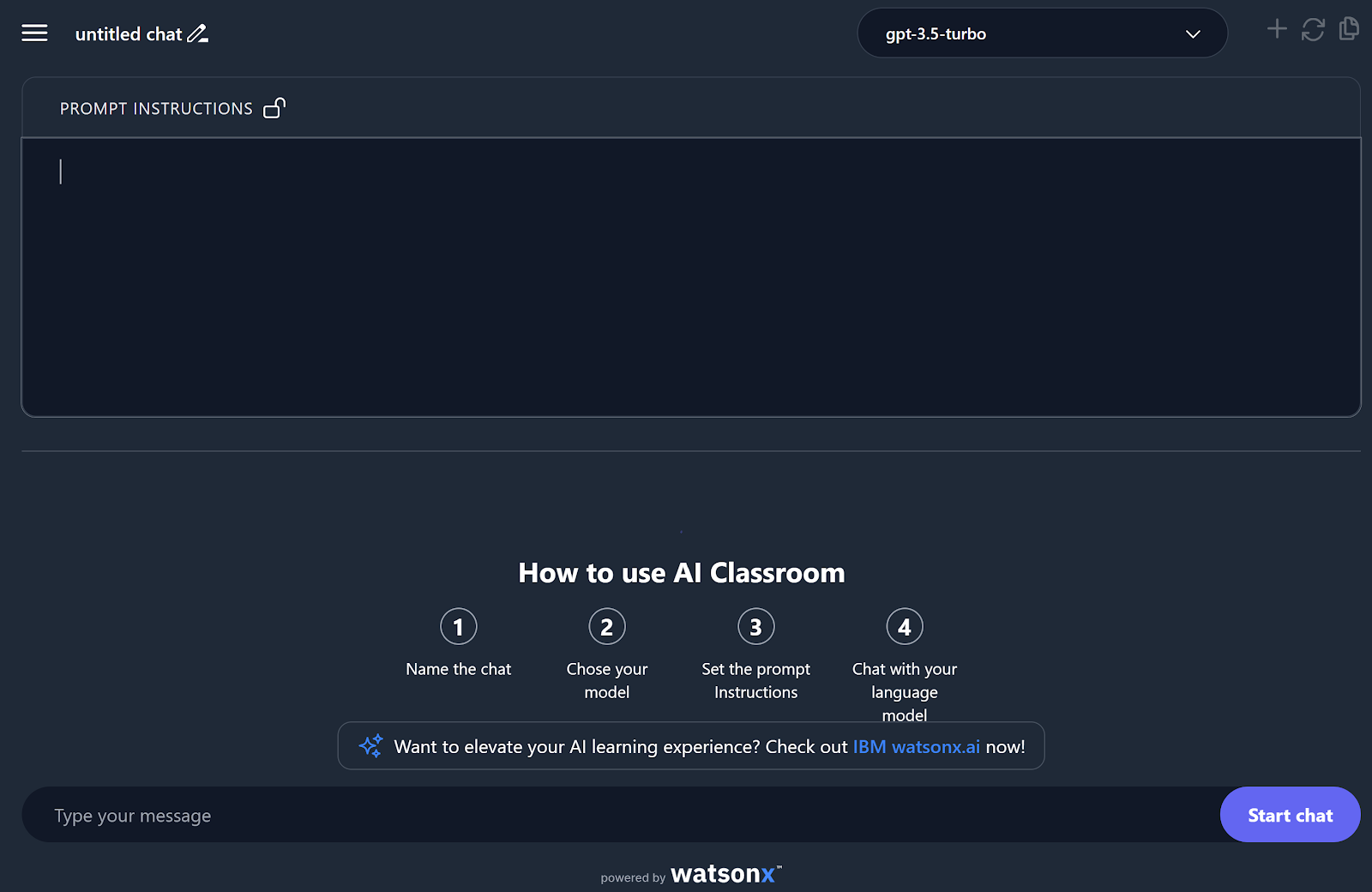
One example of providing instructions for specific chat is Prompt Instructions in Watsonx IBM service:

You define instructions in the upper input and then start to chat below.

One detailed look into how generative AI works is this article exploring the differences between "Chain of thoughts" and "Tree of thoughts" - Chain of Thoughts vs Tree of Thoughts for Language Learning Models (LLMs)

How to work better with these systems? You can improve the output using prompt patterns or n-shot prompting - 7 Prompt Patterns You Should Know

For controlling grounding data used by an LLM and constraining it for your enterprise Gen AI solutions, consider using Retrieval Augmented Generation (RAG). You can see how to use it, for example in Azure, here - Retrieval Augmented Generation (RAG) in Azure AI Search

Additionally, to gain more from LLMs, you can explore architecture patterns and mental models as described here - Generative AI Design Patterns: A Comprehensive Guide

Saturday, December 2, 2023

A comprehensive overview of generative AI and LLMs' trends, use cases, and future implications II. - Engineering and development insights

7 weeks (from 4.9. to 22.10.2023) in the world of Large Language Models and Generative AI tools, this time more focused on the engineering side:


Prompt engineering:

Parallel processing in prompt engineering: the skeleton-of-thought technique.

Unlocking reliable generations through Chain-of-Verification - a leap in prompt engineering.

LLMOps: production prompt engineering patterns with Hamilton.

Crafting different types of program simulation prompts - defining the new program simulation prompt framework.

Some kick-ass prompt engineering techniques to boost our LLM models.

And other prompt engineering tips, a neural network how-to, and recent must-reads.


AI Development and Engineering:

The team behind GitHub Copilot shares its lessons from building the app.

Amazon Bedrock for building and scaling generative applications is now generally available.

Experience from building generative AI apps on Amazon Web Services, using Amazon Bedrock and SageMaker.

A guide with 7 steps for mastering LLMs.

Key tools for enhancing Generative AI in Data Lake Houses.

An introduction to loading Large Language models.

Introduction to ML engineering and LLMOps with OpenAI and LangChain.

MLOps and LLM deployment strategies for software engineers.

Modern MLOps platform for Generative AI.

Leveraging the power of LLMs to guide AutoML hyperparameter searches.

LLMs demand Observability-Driven Development.

LLM monitoring and observability — a summary of techniques and approaches.

How to build and benchmark your LLM evals.

A step-by-step guide to selecting and running your own generative model.

Google Research: Outperforming larger language models with less training data and smaller model sizes - distilling step-by-step.

Google Research: Rethinking calibration for in-context learning and prompt engineering.

Apache Kafka as a mission-critical Data Fabric for GenAI.

Training ChatGPT on your own data.

Hugging Face's guide to optimizing LLMs in production.

Hugging Face is becoming the "GitHub" for Large Language Models.

Building microservice for multi-chat backends using Llama and ChatGPT.

Connect GPT models with company data in Microsoft Azure.

Tuning LLMs with MakerSuite.

Fine-tuning LLMs: Parameter Efficient Fine Tuning (PEFT), LoRA and QLoRA.

How to train BERT for masked language modeling tasks.

Extending context length in Large Language Models.

Conversational applications with Large Language Models understanding the sequence of user inputs, prompts, and responses.

Using data lakes and Large Language Models in development.

How to build an LLM from scratch.

LLM output parsing: function calling vs. LangChain.

Enhancing the power of Llama 2: 3 easy methods for improving your Large Language Model.


Keeping LLMs relevant and current - Retrieval Augmented Generation (RAG).

Build and deploy Retrieval Augmented Generative Pipelines with Haystack.

Why your RAG is not reliable in a production environment.


QCon San Francisco: 

Unlocking enterprise value with Large Language Models.

A modern compute stack for scaling large AI, ML, & LLM workloads.

Saturday, November 25, 2023

A comprehensive overview of generative AI and LLMs' trends, use cases, and future implications I. - Business, technology trends and applications

7 weeks (from 4.9. to 22.10.2023) in the world of Large Language Models and Generative AI tools:


AI in Business and Technology Trends:

How OpenAI turned LLMs into a mainstream success.

Oracle outlines a vision for AI and a cloud-driven future.

Enterprise SaaS companies have announced generative AI features, threatening AI startups.

How Generative AI is disrupting data practices.

Data Provenance in the age of Generative AI.

Is ChatGPT going to take data science jobs?

40% of the labour force will be affected by AI in 3 years.

And Gartner says: 

55% of organizations are in piloting or production mode with Generative AI.

CIOs must prioritize their AI ambition and AI-ready scenarios for next 12-24 months.

More than 80% of enterprises will have used Generative AI APIs or deployed Generative AI-enabled applications by 2026.

60% of seller work to be executed by Generative AI technologies within five years.


AI Applications and Use Cases:

Large Language Models in real-world customer experience applications.

Five generative AI use cases companies can implement today.

Five use cases for CFOs using generative AI.

Revolutionizing business automation with generative AI.

Redefining conversational AI with Large Language Models.

Pros and cons of LLMs for bad content moderation.

Generative AI on research papers using the Nougat model.

Document topic extraction with Large Language Models and the Latent Dirichlet Allocation (LDA) algorithm.

Using AI to add vector search to Cassandra in six weeks.

Monday, November 13, 2023

Large Language Models and other AI tools in software development (from 4.9. to 22.10.2023)

7 weeks (from 4.9. to 22.10.2023) in the world of Large Language Models and other AI tools used for software development:

List of five free AI Tools for programmers (Amazon CodeWhisperer, ChatGPT, CodeGeeX, GitHub Copilot, Bugasura).

A more detailed comparison of AI tools for programmers - the same as above, except Bugasura - another tool - Replit - is mentioned.

And here are 5 ChatGPT alternatives for code generation (Tabnine, Kite, Codota, DeepCode, GitHub Copilot).

Comparing ChatGPT with Bard AI - for software development.

GitHub Copilot Chat in open beta - now available for all individuals in Visual Studio and VS Code.

Couchbase has introduced generative AI capabilities for SQL into Database as a Service (Couchbase Capella)

MetaGPT - ChatGPT-powered AI assistant turning text into ChatGPT-based apps.

AI Assistant for IntelliJ-based IDEs update for October 2023.

Meta open-sources code generation LLM code Llama.

A new customization capability in Amazon CodeWhisperer generates even better suggestions (Preview).

Chatting with the GM of CodeWhisperer.

How is GenAI different from other code generators?

Is AI enough to increase your productivity?

The future of AI in software development - trends and innovations.

Reimagining application development with AI - a new paradigm.

The pitfalls of using general AI in software development - a case for a human-centric approach.

The challenges of producing quality code when using AI-based generalistic models.

Applying Large Language Models (LLM) to software requirements - creating a knowledge hub of business logic and copilot for faster development.

Chat with the Oracle DB - leveraging OpenAI models to query the Oracle DB, building a Text-to-SQL tool and testing it on a public dataset.

Leveraging GPT models to transform natural language to SQL queries by training GPT to query with few-shot prompting.

Retro-engineering a database schema with LLama2 - the idea here is to ask each LLM to analyze sample data and provide some insight into what the initial data scheme might look like.

‘Talk’ to Your SQL Database Using LangChain and Azure OpenAI.

AI-Driven microservice automation - use ChatGPT to build a MySQL database model, and add API Logic Server to automate the creation of SQLAlchemy model, react-admin UI, and OpenAPI (Swagger).

Tuesday, September 19, 2023

Combining software development principles and patterns with GRASP

As software development has evolved over the years, developers have formulated best practices, principles, and design patterns to create more robust and maintainable systems. In this article, we will explore the differences between software development principles and design patterns, and then dive into the GRASP principles. We will also discuss how GRASP principles are combining principles and patterns, and how they can help us to decide what to use. 

What is the difference between software development principles and design patterns? They are both essential concepts in software engineering, but they serve different purposes and operate at different levels of abstraction.

Software development principles are essential for creating high-quality software that is efficient, maintainable, and scalable. By following these principles, development teams can reduce costs, speed up development, and create better products that meet user needs. The principles are high-level guidelines or best practices that inform the software development process. They are often broad and language-agnostic, applying to various programming languages and paradigms. Principles are promoting qualities like maintainability, modularity, efficiency, and simplicity.

You should have a very good reason any time you choose not to follow principles.

Software development design patterns help developers create better software by offering efficient, reusable solutions to common problems that arise during software design. Design patterns lead to improved code quality, easier maintainability, and more effective communication among team members. They also promote scalability, and adaptability, and serve as valuable learning tools for developers. They are more concrete and detailed than principles, providing implementation guidelines for specific design challenges. They may be more closely tied to a particular programming paradigm (e.g., object-oriented, functional, etc.).

You should have a very good reason any time you choose to implement a pattern.

One specific set of principles from object design that offers an interesting way how to think about connecting the principles and patterns is GRASP (General Responsibility Assignment Software Patterns). They were described by Craig Larman in his book Applying UML and Patterns (1997).

It addresses specific development challenges and collects proven programming principles of object-oriented design, rather than being just a set of criteria for creating better software (like SOLID).

It is more a collection of best practices answers to frequently encountered coding challenges and serves as a guide for making design decisionsIt consists of nine principles, answering specific questions:

Creator

 - Who creates an object or a new instance of a class?

 - Assign the responsibility of creating an object to a class that is closely related to it. 

Related patterns are Factory Method or Abstract FactoryThese patterns encapsulate the object creation logic, assigning the responsibility of creating objects to a dedicated factory class.
They promote low coupling and high cohesion by keeping related object-creation logic within a single class.

Information Expert

 - What responsibilities can be assigned to an object?

 - Assign responsibility to the class that has the information necessary to fulfill it. 

Helps us to increase cohesion, promotes encapsulation, and promotes maintainability.

Low Coupling

 - How are objects connected to each other? How to support low dependency, low change impact, and increased reuse?

 - Design classes with minimal dependencies on other classes to promote modularity and improve maintainability and improve reuse potential. 

The Adapter is a design pattern that helps to achieve low coupling. It introduces an adapter class that acts as an intermediary between the incompatible interfaces, reducing the coupling between the classes.

Controller

 - How are input events delegated from the UI/API layer to the domain layer, including coordinating a system operation? 

 - Assign the responsibility of handling system events to a class that represents the overall system, a subsystem, or a use case. The controller is defined as the first object beyond the UI layer that receives and coordinates a system operation. This principle helps in managing system complexity by separating UI from business logic.

The related principle is Pure Fabrication. The related design patterns are, for example, Command and Facade, or Model-View-Controller (MVC).

High Cohesion

 - How are the operations of elements functionally related? How to keep objects focused, understandable, and manageable?

 - The responsibilities of a given set of elements should be strongly related and highly focused on a rather specific topic. Breaking programs into classes and subsystems, if correctly done, is an example of activities that increase cohesion. Classes with closely related responsibilities are more understandable, maintainable, and robust.


Polymorphism

 - How to handle alternative elements based on type? How to create pluggable software components?

 - Assign the responsibility of defining a common interface to related classes, allowing them to be used interchangeably. This principle supports reusability and flexibility. Polymorphic operations should be used instead of explicit branching based on type.

You can use the Strategy pattern here. It defines a common interface for the varying algorithms, allowing them to be used interchangeably. Polymorphism is achieved by using the common interface for different implementations.

Indirection

 - How to avoid a direct coupling between two or more elements and increase reuse potential?

 - Introduce an intermediate class to mediate between other classes, thus reducing coupling and promoting flexibility.

When you want to reduce coupling between a group of classes that communicate with each other, you can apply the Mediator pattern. This pattern introduces a mediator class that acts as an intermediary, managing the communication and relationships between the classes. Another related pattern is, for example, the already mentioned Adapter.

Pure Fabrication

 - How to achieve high cohesion and low coupling of problem domain elements?

 - Assign a responsibility to an artificial class, created just for the purpose of achieving High Cohesion and Low CouplingCalled a ‘service’ in domain-driven design, this class does not represent anything from the problem domain but is created to ensure High Cohesion and Low Coupling are achieved.

Protected Variations

 - How to design objects, subsystems, and systems so that variations in these elements do not impact other elements?

 - Design the system in a way that it is stable in the face of changes by encapsulating variations.

Protected Variations help us to achieve the Robustness of our system. 

You can use the Bridge pattern to ensure that changes in one class hierarchy don't affect another. This pattern separates an abstraction from its implementation, protecting the variations by encapsulating them within separate class hierarchies.


Understanding software development principles, design patterns, and GRASP principles is crucial for developers to create maintainable, scalable, and robust software systems. Applying GRASP principles helps in making better design decisions and potentially choosing the right design pattern for specific problems. 

For instance, if you need a way to create objects of different types based on input data, consider the Factory pattern (based on the Creator and Polymorphism principles).

By following these guidelines, developers can improve the overall quality of the code.

Tuesday, August 29, 2023

ChatGPT and ASCII art

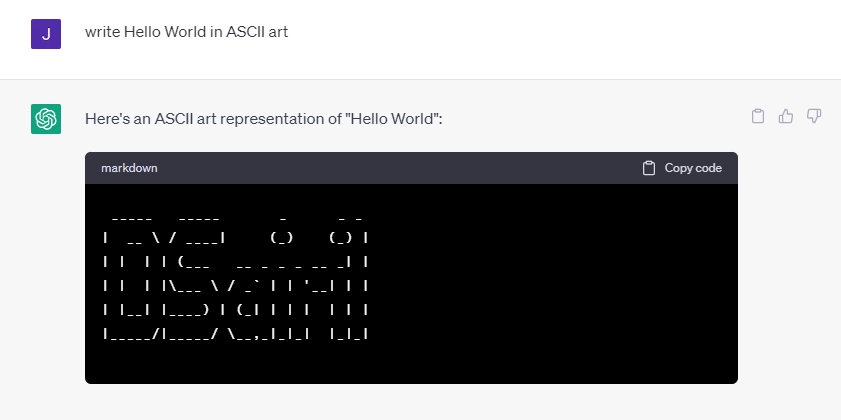
Some time back, while experimenting with the ChatGPT service, I decided to try how proficient these language models are in dealing with ASCII art - a form of visual art that uses characters from the ASCII character set to create images and designs.
Presented below are the outputs generated by three distinct versions of the ChatGPT model that were available at that time, all in response to "write Hello World in ASCII art" prompt:

Legacy GPT-3.5:

Default GPT-3.5:


GPT-4:

As you can see, ASCII art presents a unique challenge for language models like ChatGPT. While these models excel at generating human-like text, their inability to effectively comprehend and create ASCII art remains evident.

The inability of ChatGPT models to handle ASCII art is attributed to their design, which is primarily centered around processing and generating text-based data. ASCII art, however, involves a visual and spatial understanding that goes beyond simple language patterns. The models cannot interpret the exact placement, sizing, and arrangement of ASCII characters to create complex visual designs.

The inability to effectively handle ASCII art exemplifies the gap between textual and visual comprehension within these models.

Friday, May 12, 2023

Vzkříšení II.

Sledoval, jak se okolní stavby začaly hroutit, jídelna se začala sesypávat s nimi a nakonec zmizela v hromadě sutin. Celou čtvrtinu základny zachvátily plameny a na oblohu se vzneslo množství dronů, pohybujících se v uskupeních, připomínající splašená hejna ptáků.

Základna měla tvar kříže a v jejím středu se nacházel kosmodrom. Každé rameno kříže tvořily dvě dlouhé plošiny s jeřáby a dalším vybavením. Při bližším pohledu se zřetelný tvar rozplynul a celá scéna připomínala obrovské mraveniště hemžící se nespočtem malých dronů a nepravidelných funkčních struktur.

Jedna strana základny byla vážně poškozená, plameny se mísily se sytě oranžovou září hvězdy, která se rozptylovala v atmosféře. Hvězda, která se na obloze jevila dvakrát větší než Slunce, visela nízko, těsně nad obzorem, a její tvar byl zkreslený refrakcí.

To bylo vše, co na záznamu mohl vidět. Jeho poslední vzpomínka před událostí byla jak usínal ve svém pokoji - mezi událostí a touto vzpomínkou byla devatenáctihodinová mezera. K dispozici byly i další videozáznamy, ale na nich byl zachycen pouze při chůzi po chodbách. Rozhodl se, že si je prohlédne později.

"Probudil jste se po šedesáti osmi hodinách, po tom, co se nám podařilo omezit následky výbuchu a zajistit dostatečné zdroje. Útok na základnu byl jedním z několika souběžných útoků v systému. K dalším incidentům došlo na druhé planetě a v důlních zařízeních ve vnějších oblastech. Ztratili jsme téměř veškeré spojení s hypernetem, zůstaly jen dva malé datové portály. Další připojení dorazí v příštích osmi měsících prostřednictvím nadsvětelných lodí z nejbližšího strongpointu," řekl hlas a dodal: "To je vše, co vám mohu prozatím říci."

Hlas byl jeho jediným zdrojem informací od probuzení. Když se odmlčel, obklopilo ho děsivé ticho a prázdnota. Nebylo nic vidět - jen prázdnota a jeho myšlenky.

Monday, May 8, 2023

Vzkříšení I.

Na tmavě modré hladině oceánu byly velkými vlnami zmítány malé úlomky ledu. Ze vzdálenosti pozorovatele se tyto vlny zdály poměrně bezvýznamné. Mrazivý exteriér osvětlovaly slabé oranžové paprsky světla vycházející ze zakrytého obzoru, skrytého hned za věžovou konstrukcí.

Obloha byla směsicí temně rudé a modré barvy, na níž se až na několik jemných cirrových útvarů téměř nevyskytovaly mraky. Chladné počasí bylo naštěstí od útulné jídelny odděleno průhlednou bariérou. V tuto hodinu v jídelně panoval čilý ruch, protože se lidé z okolních laboratoří shromáždili kolem dlouhého bufetového stolu, na kterém se nacházely dvě dlouhé porce in vitro masa - rybího a hovězího.

Korven se však soustředil především na venkovní scenérii, hleděl na oblohu a oběma rukama svíral hrnek teplého čaje. Byl ztracený v hudbě, která mu hrála v uších, nerozptylován žádnými zprávami z domova, jen tak chvíli odpočíval. Právě dojedl a dál pozoroval výhled, rámovaný staveništěm s četnými mechanickými rameny a jeřáby po obou stranách. Přímo pod sekcí, v níž se nacházela jídelna, kotvil osamělý trimaránový dron.

A pak...

Friday, May 5, 2023

Červí hnízdo I.

Matně osvětlené ledové krystalky, sotva viditelné, ležící roztroušené na zemi, se začaly pohybovat v důsledku pohybů pod zemí. Pohybující se půda odhalila podlouhlého, mnohonohého hmyzího tvora, připomínajícího bezbarvého ostnitého červa - nepojmenovaný druh, reprezentovaný pouhým genomickým záznamem v katalogu. Tvor se probudil z letargického sběru energie v podzemí, když ho vyburcovaly teplé poryvy větru. Vítr vycházel ze všudypřítomného karmínového obzoru, občas zastřeného mraky.

Tvor začal zhluboka dýchat čerstvý vzduch z atmosféry, atmosféry s nízkým obsahem kyslíku. Čerstvý vzduch naplnil jeho tělo mnoha nosy, rozmístěnými po celém těle. Zatímco právě stál, začaly se mu na zádech objevovat dva, v porovnání s jeho tělem poměrně malé, páry křídel.

Na obloze vyčnívala o něco jasnější červená tečka - červený trpaslík, dvojče domovské hvězdy planety a součást tohoto dvojhvězdného systému. Ačkoli byl momentálně osamocený, občas ho na obloze doprovázely planety putující ve vnějších částech soustavy. Tvor viděl tuto hvězdu jasněji, protože je jeho zrak posunutý dále do infračerveného spektra, kde červení trpaslíci vyzařují většinu své elektromagnetické energie. Tento typ vidění je zde užitečnější, pomáhá při hledání potravy a úkrytů, typicky míst vyzařujících teplo z podzemí, kde v chladnějších oblastech planety, kousek od terminátoru, sídlí většina živočichů.

Samci se instinktivně pohybují dále od terminátoru, směrem k chladnějším částem planety, aby si zde našli partnerku. Samice, větší a odolnější, žijí v nejchladnějších obyvatelných oblastech, tak, aby odrazovaly predátory, a přinutily samce k celoživotnímu výkonu, který takto vede k přirozenému výběru nejsilnějších jedinců. V rozlehlé zmrzlé pustině se navzájem poznávají za pomoci infračerveného blikání, částečně viditelného i ve viditelném světle. Samec je nakonec zkonzumován - ale stejný osud čeká i samice. Ty se vracejí zpět blíže k terminátoru, kde nakonec slouží jako potrava pro své potomky. V nejlepších případech se na sklonku svého života obětují dravci nebo mrchožroutovi a přenesou svá mláďata jako parazity na nového hostitele.

Cesta tohoto konkrétního samce byla však náhle ukončena. Noha dálkově ovládaného avatara ho rozdrtila a vyřadila z genofondu planety. Avatar ale pokračoval ve své rychlé cestě vydávajíc se hlouběji do temnoty odvrácené strany planety.